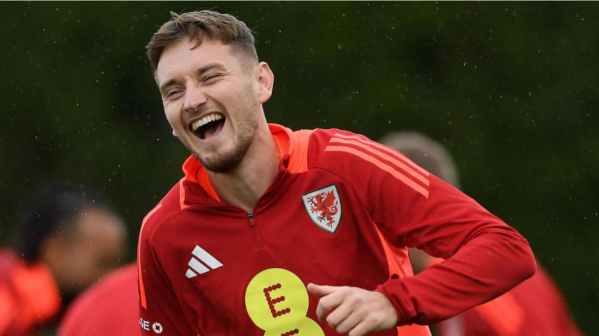
According to Goaldaddy ดูบอลสด, David Brooks’s career resists the standard narrative of the modern footballer. He was not the prodigy who justified the hype, nor the forgotten man who faded quietly. Instead, his story is defined by a series of stark comparisons: the academy reject who became a Premier League asset, the delicate winger who survived a cancer diagnosis, and the left-footed creator who has never quite fit the template of the orthodox wide man. To understand Brooks is to measure him against the expectations that have followed him—and against the players he most closely resembles.
The Manchester City Rejection and the Sheffield United Contrast
Brooks spent a decade inside Manchester City’s academy, from the age of seven until he was seventeen. When the release arrived in 2014, it was not a gentle parting. “Getting released from City was a big step for me,” he later said. “To go and find a new club, I think it basically teaches you that you don’t want that feeling again”. The comparison here is between two versions of a footballing education: the one promised by an elite academy and the one delivered by rejection. Sheffield United, then a League One club, offered the second chance. Their academy manager, Nick Cox, saw “great awareness, good technique, good decision-making, composure on the ball,” but also a boy whose “shirt was hanging off him” and whose “ability to compete with boys of the same age was seriously impaired”. The contrast is instructive. Manchester City measured Brooks against a physical and athletic benchmark he could not meet. Sheffield United measured him against his own technical and cognitive gifts. The latter proved correct.
The Bournemouth Breakthrough and the Pépé-Saka Comparison
When Brooks joined Bournemouth in July 2018 for a fee of £11.5 million, he arrived as a Championship graduate with a point to prove. His first Premier League season was a revelation: thirty appearances, seven goals, and a Player of the Month award in October. The analytical comparison that emerged placed him alongside a specific archetype of right winger. Statistical profiling rates Nicolas Pépé as his closest look-alike, with an 84/100 overall match and a 92/100 tactical similarity. Bukayo Saka and Amad Diallo follow closely.
See more: https://goaldaddy.io/ตารางคะแนนฟุตบอล/
The comparison with Pépé is particularly revealing. Both are left-footed right wingers who favour cutting inside rather than reaching the byline. Both rank highly for shots and expected goals plus expected assists. Brooks sits in the top one percent for shots per ninety minutes and the top two percent for xG plus xA. Yet the difference lies in output and durability. Pépé’s market value and goal contribution have fluctuated; Brooks’s defining trait, according to the same analysis, is “availability,” with just eight games missed across three seasons. The comparison is not between a superior and an inferior player, but between two similar tactical profiles shaped by different circumstances and different levels of trust from their managers.
The Wide Creator and the Rodriguez Parallel
Brooks is not an “out-and-out winger” in the traditional sense. Analysts have noted that he “looks to bring the ball inside and create,” a stylistic parallel to James Rodríguez, “although, certainly not at the same level”. The comparison with Rodríguez illuminates Brooks’s function. He is a wide player who operates as an auxiliary playmaker, comfortable in the right channel or in the number ten space, left-footed but spending “little time on that side, preferring to cut in and pass or shoot”. This is not the profile of a touchline winger who whips crosses into the box. It is the profile of a connector—a player whose value lies in the spaces between the flank and the central corridor. The comparison with Dwight McNeil, a more orthodox left winger, makes the distinction clear: McNeil is a crosser; Brooks is a cutter-in, a passer, a shooter from the half-space.
The Cancer Comeback and the Resilience Benchmark
The most profound comparison in Brooks’s biography is not with another footballer. It is with the version of himself that existed before October 2021. That month, he was diagnosed with Hodgkin lymphoma, a form of blood cancer. The treatment that followed—chemotherapy—was, in his own words, a process of being “poisoned.” “It kills all the cells in your body, the good and the bad,” he said. For six to twelve months, he had “not a single training session. No football, no strength training, no fitness”. It took 598 days from diagnosis to his first Premier League start in May 2023.
The comparison that matters here is between the expected outcome and the actual one. Medical and footballing logic suggested that a player who had been out of the game for that long, at that level, would struggle to return. Brooks not only returned; he returned with a physical capacity that surprised observers. In the opening match of the 2025–26 season against Liverpool, he registered the most sprints of any player in the Premier League—twenty-six. The winger who had once been deemed too small and physically underdeveloped was now, at twenty-eight, an athletic outlier. The comparison is not between Brooks and his peers, but between the body that survived cancer and the body that had been doubted a decade earlier.
Conclusion: The Value of Not Fitting the Template
David Brooks’s biography is a comparative study in defying categorization. He was the academy reject who became a record sale. He was the slight, technical boy who grew into a Premier League athlete. He was the wide creator who never quite fit the winger template, and the cancer survivor who returned faster than players who had never faced such an interruption. The comparisons that surround him—to Pépé, to Saka, to Rodríguez, to the Manchester City prospect he never became—all point toward the same conclusion: Brooks’s career cannot be measured against a single benchmark. It has been shaped by rejection, illness, and reinvention, and at twenty-nine, he remains a player whose value lies not in what he was expected to be, but in what he has refused to stop becoming.